How to Read a Hallmark
This guide, ‘How to Read a Hallmark’, has helpful information about what a hallmark is and what to look out for when shopping for jewellery.


This guide, ‘How to Read a Hallmark’, has helpful information about what a hallmark is and what to look out for when shopping for jewellery.

This post has been extracted from an article by Dippal Manchanda, Technical Director & Chief Assayer at Birmingham Assay Office. Read the full article here.

Gold, in its purest form, is naturally yellow. To achieve different colours, gold is often alloyed with other metals to give it a white or pink tone. An ‘alloy’ is a mixture of two or more metals, often created to influence a metal’s colour or durability. To create ‘white gold’ and achieve a white hue, gold is alloyed with another metal like palladium or silver. It is then usually plated with Rhodium to give it a finished white hue.
For decades, the term ‘white gold’ was loosely applied to any gold alloy that appeared white, even if it had a yellow or greyish hue. With so much variation, there was a need to standardise what constitutes ‘white gold’. This work was undertaken by Birmingham Assay Office in collaboration with Cookson Precious Metals. This work culminated in the adoption of an industry-wide definition, known as the MJSA Definition, which is now accepted around the world.

Not all alloys produce the same degree of whiteness. The ASTM Yellowness Index categorises 3 different standards of white gold alloys, creating a robust determination of what can and cannot be described and sold as white gold. These categories give clarity to consumers, manufacturers and retailers alike. According to this Index, a gold alloy can only be described as ‘white gold’ if it falls below a Yellowness Index score of 32.0.
The 3 categories of the Yellowness Index are:
We can also understand white gold alloys based on their composition and how each component added to an alloy can influence the final colour result.
No matter what the alloy for white gold contains, the final composition must contain set standards of pure gold to meet fineness or carat requirements.
This includes:
In the past, it was extremely difficult to create a white gold alloy that met the requirements for 916 or 22ct gold. This fineness must contain at least 91.6% pure gold, which gives it a strong yellow colour and a limited scope for alloying. However, recent advancements in metallurgy have made it possible to produce a 22ct white gold alloy. Combined with Palladium, this creates an off-white alloy, opening up new possibilities for high-purity white gold jewellery!
All these guidelines on fineness and description provide an objective basis for defining white gold beyond its surface appearance, ensuring consistency in grading across different manufacturers and markets.
So, where does Rhodium Plating fit into this process? Rhodium plating is commonly applied to white gold jewellery to enhance its white finish. While rhodium is a bright, highly reflective metal, it is only a surface treatment and not part of the alloy. Over time, this plating wears off, revealing the true colour of the underlying gold alloy.
For jewellery that gets frequent wear, like rings or bracelets, rhodium plating may not be a long-term durable solution. The thickness and quality of rhodium plating affect its longevity, but ultimately, everyday wear will erode the plating and necessitate reapplication.

This poses a challenge for both the consumer and the retailer. To ensure transparency and maintain consumer trust, retailers should be clear about the composition of their white gold jewellery. Some key points to communicate include:
The distinction between true white gold and rhodium plated off-white gold is essential for:
White gold is more than just a name—it is a scientifically defined material with measurable whiteness and a defined compositional standard. The research conducted by the Birmingham Assay Office and Cookson Precious Metals, led by Dippal Manchanda and Steven Henderson, has provided an objective framework for assessing white gold alloys, ensuring that the term is not misused. By prioritising education, transparency, and adherence to these standards, we can uphold the integrity of white gold in the jewellery industry.
Retailers and consumers alike should be equipped with this knowledge to make informed decisions. True white gold exists beyond rhodium plating, and recognising this distinction is key to maintaining quality and consumer confidence in jewellery.
Thank you to Dippal and the Birmingham Assay Office for this excellent resource for consumers to navigate white gold.


Before you make your next jewellery purchase, make sure you know what to look out for! Understanding what is and what isn’t a hallmark and how to recognise these marks is essential when shopping for jewellery online.
When shopping online, keep two key tips in mind to buy with confidence:
Before you buy, ask if it’s hallmarked.
When you receive your order, confirm it’s hallmarked!
A hallmark is a series of marks applied to an item of precious metal that tells you 3 essential details about the piece: Who, What and Where?
This example shows a minimum hallmark on 925 (Sterling Silver).


Hallmarks on precious metal jewellery over a certain weight are required by law:
For items under these weights, a hallmark is not required.
This information can help you understand what to look for before you buy.
You might see a plain 925, S925 or SV925 mark on jewellery. This is known as a Manufacturer’s Mark. This might be applied by a manufacturer when the jewellery is produced. It is not a hallmark.


Ag925 is another variation of a Manufacturer’s Mark. This mark is allowed if an item is under the minimum weight for hallmarking (7.78g for silver). If it’s over this exemption weight, by law, there should be a hallmark on the piece.
A 14k, 18ct or 14ct stamp is another kind of Manufacturer’s Mark. These types of stamps can only be used on a piece weighing less than 1 gram. But, if a piece of gold jewellery is over 1 gram, it must be hallmarked by an Assay Office.


On gold, a plain 375, 585 or 750 is another type of Manufacturer’s Mark. If the gold piece is over a gram, it must have the minimum hallmark that tells you the Who, What & Where of the piece.
This hallmark render shows what the minimum hallmark looks like on a piece of 585 (14ct) gold.
It tells you:


Some manufacturers might apply stamps like these to indicate metal fineness. These might give a piece the appearance of a hallmark, but without the required Sponsor’s Mark and Assay Office Mark, it is not a hallmark.
In the UK, it’s an offence under the Hallmarking Act for anyone in the course of business or trade to describe an un-hallmarked item as being either wholly or partly made of precious metal (unless exemption weights apply).
These requirements apply to eligible items sold on platforms like eBay, Amazon, Etsy and more.
The Assay Offices regularly encounter items that carry these Manufacturer Fineness Marks and no hallmarks. They often exceed the minimum weight and should carry a hallmark.
We have seen an increase in items carrying these marks which are not made of precious metal.
Some of these items have contained dangerous materials that are harmful to you, the wearer.
Without a hallmark, there is no way to know what you’re buying.

In the UK, precious metal jewellery descriptions are regulated under the Hallmarking Act of 1973. This ensures consumers are presented with clear and unambiguous descriptions of what they are buying at the point of sale.
As part of the Hallmarking Act of 1973, all retailers selling items of precious metal in their shop, whether in-store or online, are required by law to display a Dealer’s Notice in a spot where customers can easily find it.
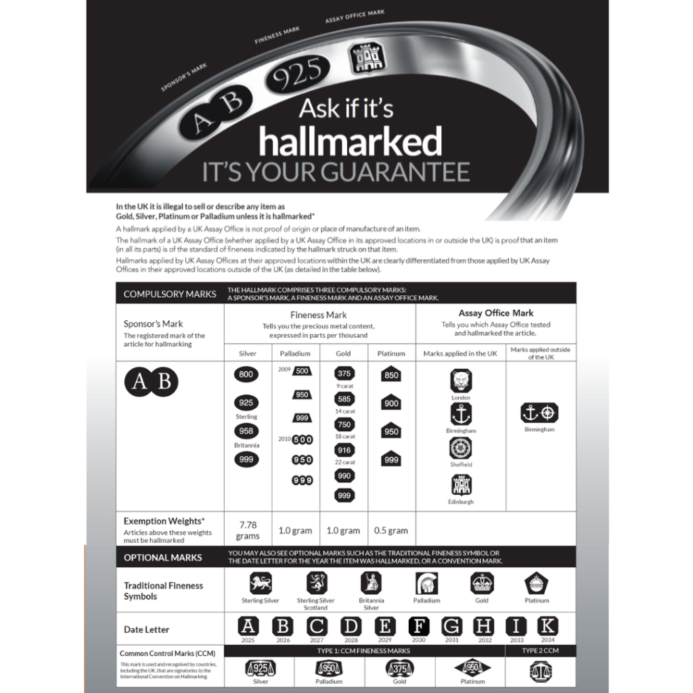
Each of the four Assay Offices in the UK can provide their hallmarking customers with a copy of the Dealer’s Notice to put in-store and online.
These notices are essential to help customers understand what the different hallmarks mean and what to look out for when purchasing items made of precious metal. Having this information readily available helps buyers make informed decisions and feel confident in their purchases.

A Dealer’s Notice describes the different types of Compulsory and Optional Marks that you may see on items of precious metal.
It also explains what the Common Control Marks (CCM) are. These are marks used by countries that are signatories to the International Hallmarking Convention. For more information on hallmarks and what they mean, visit www.assayassured.co.uk/hallmarking.
When shopping for precious metal jewellery online or in-store, look out for a Dealer’s Notice. Retailers are legally required to provide the notice to their customers.

A simple, factual description of gold vermeil is: a silver item that has been gold-plated.
The term “gold vermeil” is increasingly used to describe the process by which a piece of sterling silver jewellery is electroplated with a layer of gold onto its surface to make the silver item look gold.
The term ‘gold vermeil’ has its origins in 18th century France, where artisans applied a heavy and durable gold plating to silverware and silver jewellery. In the UK, this process was know as ‘silver gilt’.
In the UK, precious metal jewellery descriptions are regulated under the Hallmarking Act of 1973. This ensures consumers are presented with clear and unambiguous descriptions of what they are buying at the point of sale. The term ‘Gold Vermeil’ is not sanctioned under the UK Hallmarking Act of 1973. The term leads with a gold description, which can mislead consumers. It isn’t clear that the gold on their jewellery is just a plating.
The British Hallmarking Council has published guidance on the use of this term—jewellery can be described as gold vermeil, but only if the description mentions the item is made of silver and uses the phrase ‘gold plated,’ i.e. 18ct gold plated vermeil silver ring. In reality, there are no regulations on gold plating thickness in the UK, so the consumer has no means of verifying these claims. Descriptions of items being sold as Gold vermeil often make claims that the gold plating is thicker or more durable than normal gold plating.
In 2023, Assay Assured undertook a survey of items sold online being described as ‘gold vermeil’. We evaluated these product descriptions for compliance with the BHC guidance, and then purchased and measured gold-plating thickness on the items described as being gold vermeil.
If you are buying a piece of jewellery described as being ‘gold vermeil’, make sure you check the description—it should tell you the item is gold-plated silver. If the piece you are buying weighs more than 7.78g, it should also have a silver hallmark. For more information about hallmarking and what to look for, visit www.assayassured.co.uk.