
Eda Obermanns
Posts by Eda Obermanns:

Industry Welcomes Government Engagement on Hallmarking Reform
The National Association of Jewellers (NAJ) and the four UK Assay Offices have welcomed positive correspondence from the Department for Business and Trade following their joint open letter calling for targeted reform of the Hallmarking Act of 1973.
In a written response, the Minister for Employment Rights and Consumer Protection, Kate Dearden MP, acknowledged the crucial role hallmarking plays in protecting consumers and ensuring fair competition across the jewellery sector. The Minister recognised that current legislation has not kept pace with modern retail practices, particularly online selling. The Minister also confirmed the Government’s intention to modernise hallmarking arrangements when an appropriate legislative vehicle becomes available.
The Government has also invited the Assay Offices and the NAJ to meet officials to discuss the enforcement challenges faced in digital marketplaces and to explore the practical changes required to keep the system robust and future-proof.
Scott Walter, Assay Master and CEO of Edinburgh Assay Office, said, ‘For centuries, the UK hallmarking system has protected consumers and strengthened the jewellery industry, earning global respect along the way. We are committed to working closely with the Department for Business and Trade to ensure hallmarking continues to thrive within a modern, streamlined regulatory framework that supports business growth while maintaining high standards of consumer protection and fair competition.’
Ben Massey, CEO of the National Association of Jewellers, said ‘We are pleased to receive such a constructive and encouraging response from the Minister. The UK hallmarking regime provides essential consumer protection, giving people confidence that the precious metal they are buying is exactly what it claims to be. As more international sellers gain access to UK consumers, it is important that the system continues to evolve so it remains fit for purpose, supports responsible business, and protects the public. We look forward to working closely with the Department for Business and Trade to ensure the legislation keeps pace with the needs of today’s market.’
The joint open letter, submitted back in December, called for a formal consultation on several focused amendments to the Hallmarking Act, including clearer definitions for digital commerce, confirmation that digital listings constitute an “offer to sell”, extension of liability to online marketplaces, and enabling more effective enforcement in online environments. The Government has confirmed that evidence and operational insights from the Assay Offices and the NAJ will inform any future proposals.
The Assay Offices and NAJ welcome this opportunity for continued dialogue and stand ready to support the Government in shaping a modernised hallmarking framework that maintains its long‑standing integrity, enhances consumer protection, and remains a world‑leading standard.

Camden Market Trader Pleads Guilty to £100,000 of Illegal Silver
On Friday 5 February 2026, Ms Li, the proprietor of Little Swan, Stables Market, Camden, pleaded guilty to four breaches of the Hallmarking Act, 1973, at Camden Magistrates court following the seizure of £106,050 worth of silver jewellery without hallmarks by Camden Trading Standards. This marks the third successful prosecution for Operation Stamping It Out – a pioneering hallmarking education and enforcement project – which is delivered by WRi Group in partnership with Trading Standards departments across London, the Southeast and Birmingham on behalf of the London Assay Office.
Ms. Li’s prosecution followed a series of covert test purchases by WRi Group and a raid by Camden Trading Standards, leading to the seizure of more than 900 pieces of silver jewellery without hallmarks. Upon conviction the proprietor of Little Swan was fined £600 (total) for the 4 offences, a surcharge of £240 and costs of £1188.87
Launched in 2023, Operation Stamping It Out aims to ensure retailers of silver, gold, platinum and palladium jewellery and objects are compliant with the Hallmarking Act (1973) through a programme of education, awareness, and enforcement. More than 480 retail premises have been visited under the programme so far, receiving guidance and advice, and when required given time to bring their trading into compliance with the Act.
However, for those that ignore the advice and flout the law, direct enforcement action is often necessary, with more than £250,000 worth of silver and gold jewellery without hallmarks seized under Operation Stamping It Out as part of active criminal prosecutions in the London Boroughs of Waltham Forest, Tower Hamlets and Camden.
Hallmarking is one of the oldest continuous forms of consumer protection in use today and can trace its origins to the reign of Henry II, more than 840 years ago. It offers customers, retailers and the trade assurance that objects made from precious metals have been independently scientifically tested (assayed), and through the marks that are applied (the Hallmark), tells them what an object is made from, when it was made, who sent it to be Hallmarked (the sponsor), and which of the four UK Assay Offices tested and marked it.
The Hallmarking Act (1973) says that – “it is an offence for any person, in the course of trade or business, to describe an un-hallmarked article as being wholly or partly made of precious metal(s) or to supply un-hallmarked articles to which such a description is applied.” and that “all dealers supplying precious metal jewellery (or other items made of precious metal) shall display a notice explaining the approved hallmarks” – and gives Trading Standards Officers the power to carry out inspections, investigate breaches, and take enforcement actions, including the seizure of objects that do not comply. However, more than a decade of austerity and the resulting budget cuts within local government has left Trading Standards departments over stretched and under resourced.
Speaking about Operation Stamping It Out and Miss Li’s prosecution, Will Evans, Director of the London Assay Office said – “Since 1478, the London Assay Office has protected consumers and the trade by ensuring the quality of precious metals, playing a pivotal role in helping the thousands of businesses that hallmark in London to achieve compliance with the Law in the UK and internationally.
We are incredibly proud to support Operation Stamping It Out and pleased that the collaboration between WRi Group and Camden Trading Standards has led to a third successful prosecution of a rogue trader in one of the Capital’s busiest marketplaces. Through this programme, which has taken more than £250,000 of illegal silver and gold out of circulation so far, we are making a clear statement of support for our industry and the people and businesses who are vital to its ongoing success.”
Graham Mogg, CEO at WRi Group, who leads on the project said – “Operation Stamping It Out is an excellent example of what can be achieved through a true collaborative approach to tackle illicit trade. Hallmarking breaches place consumers and legitimate retails at risk, and we applaud the actions taken by Camden, Tower Hamlets and Waltham Forest Trading Standards under the project to mitigate those risks”.
Images by Chris Mann


Touchstone Award Training Day
On 18 November, the British Hallmarking Council (BHC) welcomed Trading Standards officers from 8 London Boroughs for the Annual Touchstone Award Training Day. This was kindly hosted by the London Assay Office at The Goldsmiths’ Company.
The Touchstone Award, sponsored by the National Association of Jewellers (NAJ) and supported by the Chartered Trading Standards Institute (CTSI), exists to recognise Trading Standards teams who deliver exceptional work in enforcing the Hallmarking Act: protecting consumers, and supporting legitimate jewellers across the UK. With the rise of online marketplaces, fast-moving imports, and increasingly sophisticated illegal traders, effective hallmarking enforcement has never been more vital. The Award
shines a light on teams whose work preserves confidence in precious-metal goods and ensures that consumers can trust the hallmark – one of the UK’s oldest and most enduring forms of consumer protection.
A day of learning, recognition and collaboration
During the day, attendees heard directly from the winning enforcement team – London Trading Standards – about the ‘Stamping It Out’ project: an operation that has already removed more than £250,000 worth of non-compliant and illegal items from the London market. Members of the London Assay Office joined the BHC to share best practice, discuss enforcement challenges, and strengthen collaboration between
regulators and frontline Trading Standards officers. Guests were then hosted by the London Assay Office for a practical, behind-the-scenes
tour, demonstrating how hallmarking testing and verification operate in real time. This hands-on session allowed winners to deepen their technical knowledge and connect their enforcement work directly to the centuries-old processes that protect consumers and the trade.
Simon Topman, Chair, British Hallmarking Council:
“The British Hallmarking Council is honoured to celebrate success from within Trading Standards by making this annual award. Enforcement of the Hallmarking Act is essential to protect consumers and legitimate business. This year’s winners delivered a fantastic team effort and we look forward to this work being rolled out to other parts of the country.”
Stuart Radnedge, Regional Coordinator: London Trading Standards:
“We are extremely proud to have achieved such outstanding results from our operations across London. Our participating members took part because protecting consumers and legitimate businesses is a major priority for Trading Standards. Thanks must go to the British Hallmarking Council, the London Assay Office, the sponsors and organisers of the Touchstone Award for this prestigious annual event, which supports Trading Standards in enforcing hallmarking compliance at retail level and promotes the trust that people feel when they see the Hallmarking signs on jewellery”.
Will Evans, Director, London Assay Office:
“For more than 700 years, the London Assay Office has protected consumers and the trade by ensuring the quality of precious metals. We are incredibly proud to support Operation Stamping It Out, and thrilled that the collaboration between WRi Group and London Trading Standards — which has seen more than £250,000 of illegal items removed from the streets so far — has been recognised with the 2025 Touchstone Award. The dedication and professionalism shown by the teams from the London boroughs involved demonstrates how much can be achieved when we work together towards a common goal.”

How to Read a Hallmark
This guide, ‘How to Read a Hallmark’, has helpful information about what a hallmark is and what to look out for when shopping for jewellery.

Anna McLoughlin Fine Jewellery Wins UK Award for Hallmarking Awareness

Anna McLoughlin Fine Jewellery has been awarded the prestigious HALO Award in recognition of her innovative work to engage customers with the importance of hallmarking and consumer protection in the jewellery sector.
Awarded by Assay Assured, a joint venture between the four Assay Offices of the UK (Birmingham, Edinburgh, London and Sheffield), the HALO Award is given annually.
HALO recognises the UK-based jewellery business that uses their online platform in the most creative ways to leverage the added value that hallmarking provides and to educate their audience on the meaning and importance of the hallmark. Applicants this year ranged from independent makers to omni-channel retailers.
Having previously won the HALO Award in 2023, Anna McLoughlin Fine Jewellery continues to integrate a narrative around hallmarking into all aspects of the business. From an extensive, dedicated hallmarking page on her website, to certificates of provenance and collaborative social media posts, Anna’s efforts reassure customers that they are investing in a unique piece with an individual, built-in guarantee of quality. Anna’s clear, consistent and impactful story telling around the hallmarking process stood out.
‘I’m absolutely thrilled to have won the HALO award for a second time,’ said Anna McLoughlin, founder of Anna McLoughlin Fine Jewellery. ‘I feel that hallmarking, and raising awareness of it amongst both my clients and fellow micro-businesses, is incredibly important. It adds prestige to a piece and is a legal guarantee that the quality of the metal is actually what I say it is!’
2025’s judging panel comprised of:
- Eda Obermanns – Digital lead at Edinburgh Assay Office and Assay Assured
- Mari MacDonald – Product lead and head auditor at Assay Assured
- Ashley Carson – Assay Master and CEO – Sheffield Assay Office
- Doug Henry – Assay Master and CEO – Birmingham Assay Office
- Will Evans – Director – London Assay Office
- Scott Walter – Assay Master and CEO – Edinburgh Assay Office
- Ben Massey – CEO – The National Association of Jewellers
The Judges unanimously commended Anna’s creativity, transparency and clear communication, implementing efforts above and beyond the minimum requirements set out in the UK’s Hallmarking legislation.
‘Hallmarking is the oldest existing form of consumer protection and product traceability, and it remains a cornerstone of consumer protection in the UK jewellery industry. It gives consumers an independent, third-party guarantee when they are buying jewellery. Jewellery can be traced back to those that made it or placed it on the market. Other industries are pushing hard to introduce transparency and traceability—the jewellery industry has always had this in the hallmark.’ said Scott Walter, Assay Master & CEO of Edinburgh Assay Office. ‘It’s important to recognise businesses like Anna’s who see the value of the simple hallmark and work creatively and consistently to leverage that value at point of sale and beyond.’
By law, all items described as being made from precious metals above certain weight limits must be hallmarked by one of the four UK Assay Offices. The hallmark confirms the metal’s purity, identifies the individual or business putting the item on the market and ultimately protects both consumers and retailers from counterfeiting and false descriptions.
The judging panel also Highly Commended the runner-up applicant, The Ouze, by Toby Vernon and Joe Sturgis. The Ouze, based in Brighton, have built hallmarking into the design ethos of their brand.
The Award will be presented at the annual Benevolent Society Ball in Birmingham.

White Gold, Explained
This post has been extracted from an article by Dippal Manchanda, Technical Director & Chief Assayer at Birmingham Assay Office. Read the full article here.
White gold has long been a popular choice in the jewellery industry, valued for its elegance and versatility. But, what is white gold? What is it made of and how does it get its signature finish? In the UK, regulations about how precious metal jewellery is tested and described are put in place to protect consumers. This article has helpful information and background to ensure both industry professionals and consumers can make informed decisions when purchasing white gold jewellery

Gold, in its purest form, is naturally yellow. To achieve different colours, gold is often alloyed with other metals to give it a white or pink tone. An ‘alloy’ is a mixture of two or more metals, often created to influence a metal’s colour or durability. To create ‘white gold’ and achieve a white hue, gold is alloyed with another metal like palladium or silver. It is then usually plated with Rhodium to give it a finished white hue.
For decades, the term ‘white gold’ was loosely applied to any gold alloy that appeared white, even if it had a yellow or greyish hue. With so much variation, there was a need to standardise what constitutes ‘white gold’. This work was undertaken by Birmingham Assay Office in collaboration with Cookson Precious Metals. This work culminated in the adoption of an industry-wide definition, known as the MJSA Definition, which is now accepted around the world.

Not all alloys produce the same degree of whiteness. The ASTM Yellowness Index categorises 3 different standards of white gold alloys, creating a robust determination of what can and cannot be described and sold as white gold. These categories give clarity to consumers, manufacturers and retailers alike. According to this Index, a gold alloy can only be described as ‘white gold’ if it falls below a Yellowness Index score of 32.0.
The 3 categories of the Yellowness Index are:
- Premium Grade White Gold (Yellowness Index of less than 19.0). This is naturally white, and does not require any Rhodium plating.
- Standard Grade White Gold (Yellowness Index between 19.0 and 24.5). This is a mostly white alloy, and Rhodium plating is optional.
- Off-White Grade White Gold (Yellowness Index between 24.5 and 30). This alloy has a noticeably yellowish tint and needs Rhodium plating to give the alloy a white finished appearance.
We can also understand white gold alloys based on their composition and how each component added to an alloy can influence the final colour result.
- Silver whitens the alloy but can introduce a greenish hue
- Palladium whitens the alloy but adds a slight reddish tint
- Nickel is a strong whitener for an alloy
- Zinc also acts as a whitener
- Copper reduces yellowness in an alloy but also increases redness
No matter what the alloy for white gold contains, the final composition must contain set standards of pure gold to meet fineness or carat requirements.
This includes:
- 375 or 9ct alloys: these must contain 37.5% gold
- 585 or 14ct alloys: these must contain 58.5% gold
- 750 or 18ct alloys: these must contain 75.0% gold
In the past, it was extremely difficult to create a white gold alloy that met the requirements for 916 or 22ct gold. This fineness must contain at least 91.6% pure gold, which gives it a strong yellow colour and a limited scope for alloying. However, recent advancements in metallurgy have made it possible to produce a 22ct white gold alloy. Combined with Palladium, this creates an off-white alloy, opening up new possibilities for high-purity white gold jewellery!
All these guidelines on fineness and description provide an objective basis for defining white gold beyond its surface appearance, ensuring consistency in grading across different manufacturers and markets.
So, where does Rhodium Plating fit into this process? Rhodium plating is commonly applied to white gold jewellery to enhance its white finish. While rhodium is a bright, highly reflective metal, it is only a surface treatment and not part of the alloy. Over time, this plating wears off, revealing the true colour of the underlying gold alloy.
For jewellery that gets frequent wear, like rings or bracelets, rhodium plating may not be a long-term durable solution. The thickness and quality of rhodium plating affect its longevity, but ultimately, everyday wear will erode the plating and necessitate reapplication.

This poses a challenge for both the consumer and the retailer. To ensure transparency and maintain consumer trust, retailers should be clear about the composition of their white gold jewellery. Some key points to communicate include:
- Whether the jewellery is rhodium plated and why
- The natural colour grade of the white gold used
- The potential need for periodic rhodium re-plating
The distinction between true white gold and rhodium plated off-white gold is essential for:
- Consumers who deserve to know what they’re buying
- Retailers who must maintain trust and credibility
- Manufacturers who should strive for transparency and quality control
- Laboratories which need to ensure accurate testing and classification of white gold alloys
White gold is more than just a name—it is a scientifically defined material with measurable whiteness and a defined compositional standard. The research conducted by the Birmingham Assay Office and Cookson Precious Metals, led by Dippal Manchanda and Steven Henderson, has provided an objective framework for assessing white gold alloys, ensuring that the term is not misused. By prioritising education, transparency, and adherence to these standards, we can uphold the integrity of white gold in the jewellery industry.
Retailers and consumers alike should be equipped with this knowledge to make informed decisions. True white gold exists beyond rhodium plating, and recognising this distinction is key to maintaining quality and consumer confidence in jewellery.
Thank you to Dippal and the Birmingham Assay Office for this excellent resource for consumers to navigate white gold.

What Is & What is Not a Hallmark?

Before you make your next jewellery purchase, make sure you know what to look out for! Understanding what is and what isn’t a hallmark and how to recognise these marks is essential when shopping for jewellery online.
When shopping online, keep two key tips in mind to buy with confidence:
-
Before you buy, ask if it’s hallmarked.
-
When you receive your order, confirm it’s hallmarked!
A hallmark is a series of marks applied to an item of precious metal that tells you 3 essential details about the piece: Who, What and Where?
- Who made the piece or placed it on the market for sale;
- What the metal type and fineness of the piece is;
- Where the item was tested and which Assay Office applied the hallmarks.
This example shows a minimum hallmark on 925 (Sterling Silver).


Hallmarks on precious metal jewellery over a certain weight are required by law:
- Gold: 1 gram
- Silver: 7.78 grams
- Platinum: 0.5 grams
- Palladium: 1 gram
For items under these weights, a hallmark is not required.
This information can help you understand what to look for before you buy.
You might see a plain 925, S925 or SV925 mark on jewellery. This is known as a Manufacturer’s Mark. This might be applied by a manufacturer when the jewellery is produced. It is not a hallmark.


Ag925 is another variation of a Manufacturer’s Mark. This mark is allowed if an item is under the minimum weight for hallmarking (7.78g for silver). If it’s over this exemption weight, by law, there should be a hallmark on the piece.
A 14k, 18ct or 14ct stamp is another kind of Manufacturer’s Mark. These types of stamps can only be used on a piece weighing less than 1 gram. But, if a piece of gold jewellery is over 1 gram, it must be hallmarked by an Assay Office.


On gold, a plain 375, 585 or 750 is another type of Manufacturer’s Mark. If the gold piece is over a gram, it must have the minimum hallmark that tells you the Who, What & Where of the piece.
This hallmark render shows what the minimum hallmark looks like on a piece of 585 (14ct) gold.
It tells you:
- Who made the piece or placed it on the market for sale;
- What the metal type and fineness of the piece is;
- Where the item was tested and which Assay Office applied the hallmarks.


Some manufacturers might apply stamps like these to indicate metal fineness. These might give a piece the appearance of a hallmark, but without the required Sponsor’s Mark and Assay Office Mark, it is not a hallmark.
In the UK, it’s an offence under the Hallmarking Act for anyone in the course of business or trade to describe an un-hallmarked item as being either wholly or partly made of precious metal (unless exemption weights apply).
These requirements apply to eligible items sold on platforms like eBay, Amazon, Etsy and more.
The Assay Offices regularly encounter items that carry these Manufacturer Fineness Marks and no hallmarks. They often exceed the minimum weight and should carry a hallmark.
We have seen an increase in items carrying these marks which are not made of precious metal.
Some of these items have contained dangerous materials that are harmful to you, the wearer.
Without a hallmark, there is no way to know what you’re buying.

The HALO Award 2025
The HALO Award is back for 2025!
We’re looking for the jewellery business that uses their online platforms in the most creative ways to engage customers with hallmarking.
Whether you’re an independent maker or an omni-channel retailer, we want to hear from you! The winning applicant will receive a year’s subscription to Assay Assured, a visit to an Assay Office, supporting press and more.
The HALO Award is managed by Assay Assured, a joint initiative between the four UK Assay Offices: Birmingham, Edinburgh, London and Sheffield.
This award is recognition from the industry that your business embraces the long-standing tradition of hallmarking in the UK through a fresh, modern perspective.
For more info on the award, eligibility and more, visit www.assayassured.co.uk/halo. Applications close 30 May 2025

What is a Dealer’s Notice?
In the UK, precious metal jewellery descriptions are regulated under the Hallmarking Act of 1973. This ensures consumers are presented with clear and unambiguous descriptions of what they are buying at the point of sale.
As part of the Hallmarking Act of 1973, all retailers selling items of precious metal in their shop, whether in-store or online, are required by law to display a Dealer’s Notice in a spot where customers can easily find it.
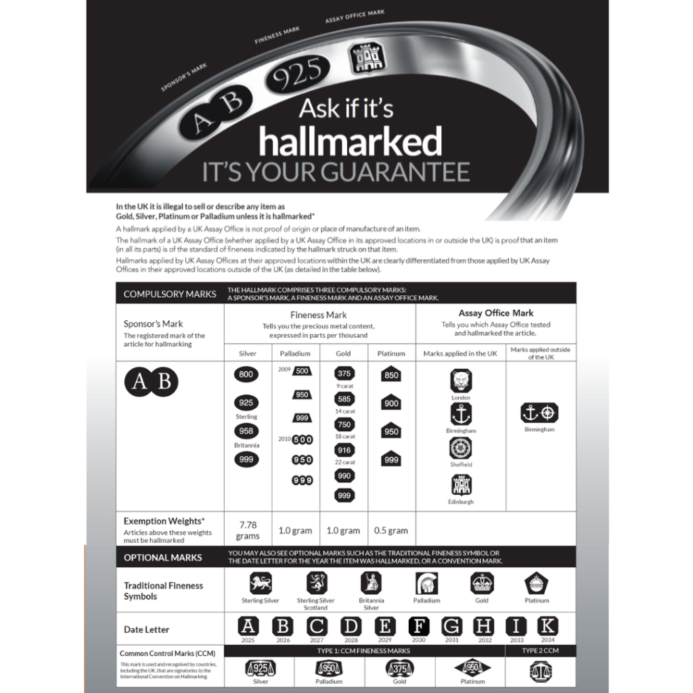
Each of the four Assay Offices in the UK can provide their hallmarking customers with a copy of the Dealer’s Notice to put in-store and online.
These notices are essential to help customers understand what the different hallmarks mean and what to look out for when purchasing items made of precious metal. Having this information readily available helps buyers make informed decisions and feel confident in their purchases.

A Dealer’s Notice describes the different types of Compulsory and Optional Marks that you may see on items of precious metal.
It also explains what the Common Control Marks (CCM) are. These are marks used by countries that are signatories to the International Hallmarking Convention. For more information on hallmarks and what they mean, visit www.assayassured.co.uk/hallmarking.
When shopping for precious metal jewellery online or in-store, look out for a Dealer’s Notice. Retailers are legally required to provide the notice to their customers.

Hannah Louise Lamb
This November, we are pleased to collaborate with North-Berwick based Jeweller Hannah Louise Lamb. Hannah has recently become a Certified Assay Assured Retailer, reflecting her commitment to consumer protection and high-quality craftsmanship. We spoke with Hannah to get some insight into her work, process and why hallmarking is important to her business.
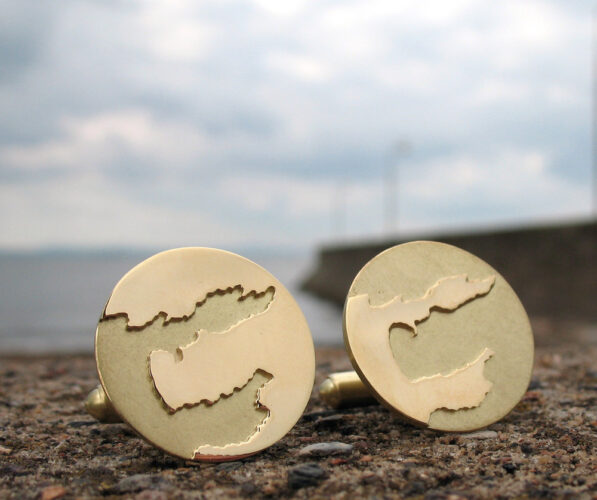
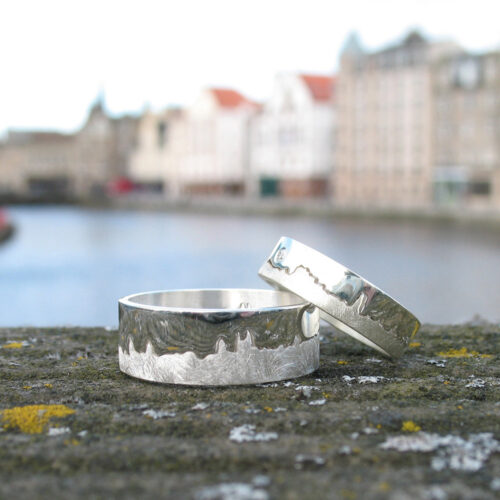
Working from her studio in North Berwick, Scotland, Hannah specialises in creating bespoke jewellery that reflects life’s personal stories. Inspired by the rugged beauty of nature and the idea that jewellery can encapsulate the cherished moments of our lives, Hannah’s pieces reflect coastlines, skylines and landscapes of special significance to each of us. From intricate hand-piercing to painstaking cut-outs, Hannah consistently captures unique and personal stories with the highest level of craftsmanship and experience. As a graduate of Glasgow School of Art and The Royal College of Art, Hannah has completed commissions for The Bodleian Library, The Scottish Government and Scottish Opera as well as taking part in international residencies and workshops.

Can you tell us a bit about your design process?
My designing is always informed by my fabulous customers. I specialise in creating bespoke jewellery pieces that reflect life’s personal stories. My pieces represent coastlines, skylines and landscapes of special significance to each of us. I use hand-piercing to capture my customer’s unique and personal stories.
Why is hallmarking important to you and your business?
An essential part of quality craftsmanship within the world of jewellery is ensuring every piece meets the high standards carved out by the Edinburgh Assay Office. As a business, hallmarking stamps serve as my guarantee of the metals used in the creation of my handmade jewellery, providing assurance of authenticity and quality to my customers.


What materials do you prefer to work with and why?
My absolute favourite metal is 18ct yellow gold, it’s just gorgeous! But I love working with sterling silver, and all colours and carats of gold. I use 100% recycled, or Single Mine Origin metals for my designs.
Is there a specific part of the hallmarking process that interests you?
I love that all my pieces that are hallmarked have my maker’s mark, which is an oval with the initials HL, and the Edinburgh Castle, along with the other standard marks.

How do you engage with your customers about hallmarking?
As most of my jewellery is sold online, I have explained the marks on my website with a page dedicated to hallmarking.
What is the one thing you wish your customers knew about hallmarking?
Hallmarking is a guarantee of assurance that the jewellery the public are buying is made from that metal it is described as. A hallmark is made up of series of marks, representing the maker, the metal fineness, and the year. A 925 stamp on it’s own is not a hallmark.
Images by Hannah Louise Lamb & Helen Pugh Photography

Hannah Louise Lamb x Assay Assured Giveaway

We are thrilled to collaborate with North Berwick-based jeweller, Hannah Louise Lamb, on an exciting giveaway this November!
Hannah has recently become a Certified Assay Assured retailer, reflecting her commitment to consumer protection and high-quality craftsmanship. One winner will receive a beautiful, custom-made piece from Hannah’s signature Coastline collection. The winner will collaborate with Hannah to create a piece based on a coastline they treasure, which Hannah will translate into one of her intricately hand-pierced pieces.
TERMS & CONDITIONS
- Eligibility: This giveaway is open to all Instagram and Facebook users based in the UK who are 18 years or older at the time of entry. Employees of Assay Assured, its affiliates and subsidiaries are not eligible to participate in this giveaway.
- How to Enter: To enter the giveaway, participants must
- Instagram
- Like the giveaway post
- Follow @assayassured on Instagram
- AND/OR
- Facebook
- Like the giveaway post
- Follow Assay Assured on Facebook
- For one additional entry on both Instagram and Facebook, tag a friend in the comments.
- The total number of entries possible per account is 4 (2 via Instagram and 2 via Facebook).
- Instagram
- Entry Period: The giveaway begins on 4 November 2024 and closes on 20 November 2024. Entries submitted before or after the entry period will not be eligible.
- Prize: One (1) winner will receive a piece of custom jewellery by Hannah Louise Lamb. The prize is non-transferable and no cash or other prize subscription is permitted. The winner will liaise directly with Hannah to create a custom piece from her coastline collection. The type of piece will be selected from a list pre-approved by Hannah. The winner will receive the finished prize no later than 28 February 2025.
- Winner Selection & Notification: The winner will be selected in a random draw done by Assay Assured. The winner will be notified via Instagram or Facebook direct message within 7 days. Assay Assured shall have no liability for a winner’s failure to receive notices due to spam, junk e-mail or other security settings or for a winners provision of incorrect or non-functioning contact information.
- Claiming the Prize: If the selected winner cannot be contacted, is ineligible or fails to confirm contact information within 7 days from the time of the award notification, the prize may be forfeited and an alternate winner will be selected. The winner must agree to be contacted by e-mail by both Assay Assured and Hannah Louise Lamb for award fulfillment.
- Purpose: This giveaway is part of a collaboration between Assay Assured and Hannah Louise Lamb. The purpose of this giveaway is to promote consumer awareness of hallmarking and Assay Assured, the trustmark for buying jewellery online.
General Conditions: Assay Assured reserves the right to cancel, suspend and/or modify the giveaway, or any part of it, if fraud, technical failures or any other factor beyond Assay Assured’s reasonable control impairs the integrity or proper function of the giveaway, as determined by Assay Assured.
Limitation of Liability: By entering this giveaway, you agree to the terms and conditions of the giveaway and agree to release Assay Assured and any of its affiliates or subsidiaries from any liability, loss, litigation, claim or damage that may occur, directly or indirectly, from your participation in the giveaway.
This giveaway and these Terms & Conditions are governed by the laws of Scotland and any disputes will be subject to the exclusive jurisdiction of the Scottish courts.
Privacy policy: Information submitted with an entry is subject to the Privacy Policy stated on the Assay Assured website.

Understanding Gold Vermeil
A simple, factual description of gold vermeil is: a silver item that has been gold-plated.
The term “gold vermeil” is increasingly used to describe the process by which a piece of sterling silver jewellery is electroplated with a layer of gold onto its surface to make the silver item look gold.
The term ‘gold vermeil’ has its origins in 18th century France, where artisans applied a heavy and durable gold plating to silverware and silver jewellery. In the UK, this process was know as ‘silver gilt’.
In the UK, precious metal jewellery descriptions are regulated under the Hallmarking Act of 1973. This ensures consumers are presented with clear and unambiguous descriptions of what they are buying at the point of sale. The term ‘Gold Vermeil’ is not sanctioned under the UK Hallmarking Act of 1973. The term leads with a gold description, which can mislead consumers. It isn’t clear that the gold on their jewellery is just a plating.
The British Hallmarking Council has published guidance on the use of this term—jewellery can be described as gold vermeil, but only if the description mentions the item is made of silver and uses the phrase ‘gold plated,’ i.e. 18ct gold plated vermeil silver ring. In reality, there are no regulations on gold plating thickness in the UK, so the consumer has no means of verifying these claims. Descriptions of items being sold as Gold vermeil often make claims that the gold plating is thicker or more durable than normal gold plating.
In 2023, Assay Assured undertook a survey of items sold online being described as ‘gold vermeil’. We evaluated these product descriptions for compliance with the BHC guidance, and then purchased and measured gold-plating thickness on the items described as being gold vermeil.
If you are buying a piece of jewellery described as being ‘gold vermeil’, make sure you check the description—it should tell you the item is gold-plated silver. If the piece you are buying weighs more than 7.78g, it should also have a silver hallmark. For more information about hallmarking and what to look for, visit www.assayassured.co.uk.

The Touchstone Award
The Touchstone Award, sponsored by the British Hallmarking Council, is one of a number of awards the BHC gives out each year. This award encourages Trading Standards Authorities to identify and take action against retailers who flout the law by selling jewellery with misleading descriptions.
Trading Standards is a network across the UK that focuses on national and regional consumer protection and enforcement, tackling rogue traders and dishonest businesses. The goal of all trading standards services is to ensure legitimate businesses can thrive and consumers can buy products with confidence.
Over the last 12 years of the Touchstone Award, findings detailed in applications clearly illustrate the need for both enforcement of and education about hallmarking. Fine jewellery is not an everyday purchase for most people, and it can be easy to cheat consumers if they don’t have an existing understanding of what a hallmark is and why it’s important.
Over a 6-month period in 2019, an online ebay trader sold over 400 ‘platinum and diamond’ engagement rings carrying a lone 950PT mark. This symbol is not a hallmark, but a manufacturers mark used in the trade. Many online retailers misleadingly list this symbol as a genuine hallmark, but it carries no legitimacy in the International Hallmarking Convention or British Hallmarking Convention. The item sold by this ebay trader retailed for £150. A test purchase made by the National Association of Jewellers revealed that the ring was made of Cubic Zirconia and silver, with a true retail value of £50. If the ring had actually been made of Platinum and diamonds, the value would have been nearer to £8,000.
The 2024 Touchstone Award was presented to Hull City Council at the recent conference of the Chartered Trading Standards Institute. Hull City Council have worked closely with Sheffield Assay Office to circumvent retailers profiting off mis-selling base metal jewellery. In 2023, suspicions rose for Hull City Council relating to an online trader selling large volumes of ‘gold’ chain from a residential address. Subsequent investigation revealed this to all be base metal. A search of the premises found enough stock to create 30,000 chains, all cut from a reel of chain and stamped afterwards. The total retail value of the seized chains amounted to £400,000, a huge potential loss of sales to honest jewellers.
The biggest weapon the jewellery trade has to combat rogue traders and those ignorant of the law is to educate and inform consumers. While the Touchstone Award has done much to raise the profile of hallmarking, educating consumers is essential in building a stronger and more resilient industry.
(Image: Presentation of the Touchstone Award to Hull City Trading Standards at the CTSI Conference in Leeds in June. L to R: Chris Wilson (City Trading Standards Officer), Ian Mattinson (Senior Trading Standards Officer), Rachel Stephenson (Head of Public Protection), Adam Jacobs (NAJ Chair) and at the end Rav Wilding (Master of Ceremonies).)

New Trustmark Scheme to crackdown on counterfeit jewellery sold in the UK
The Assay Assured Trustmark scheme is to re-launch today (Wednesday March 1st) with the support of all four UK Assay offices for the first time.
The relaunch includes a brand-new Trustmark design featuring a crown in place of a castle, allows for a unique certification number for each jeweller and will incorporate new options for multi-channel retailers
When it was first launched in 2012 by the Edinburgh Assay office it was the world’s first consumer online assurance scheme for the jewellery industry.
Businesses that sign up to the scheme can display Assay Office credentials to shoppers browsing their website. Details of the business’ registration are visible to shoppers giving them the assurance of adherence to the hallmarking law. An additional layer of reassurance is provided within the product itself if the hallmark cannot be seen in the product image.
A recent survey conducted on behalf of the British Hallmarking Council by brand protection group, WRi, found that a third of “gold” jewellery being sold online is suspected not to be hallmarked and therefore may be fake, raising concerns that UK consumers are being duped by internet traders.
The UK hallmark is the original trustmark and one of the oldest forms of consumer protection. It is important because it helps to establish trust and confidence between businesses and customers by providing assurance of security, privacy, authenticity, and reputation.
Scott Walter, Assay Master and Chief Executive at the Edinburgh Assay office and Assay Assured, said:
“We are really excited that the Assay Assured certification scheme will now incorporate the combined weight of all 4 UK Assay Offices. As online retail channels evolve for the jewellery industry the importance of independently verified data points must evolve too.
Independent, digital verification is critical and allows a range of stakeholders to know that they can trust the marketing claims they read and be assured that the product is compliant. Assay Assured will remain focused on building trust, promoting excellence, and levelling the playing field.”
Will Evans, General Manager of The Goldsmiths Company Assay office, London, said:
“Assay Offices have been protecting customers in the UK for almost 700 years, this initiative aims to bring that protection to shoppers who increasingly purchase luxury products online. Giving them extra reassurance that their retailer of choice complies with the Hallmarking Act.”
Doug Henry, Assay Master and Chief Executive of the Assay office in Birmingham, said:
“Assay Assured is an excellent programme, driven by the UK Assay Offices, designed to safeguard consumers and prevent mis-selling through the provision of an independent verification of compliance of their chosen retailer, be that in-store or online.”
Ashley Carson, Assay Master and Chief Executive of the Sheffield Assay office, said:
“Each UK Assay has been engaged separately in initiatives to encourage legitimate online retailers promote hallmarking. The re-launch of Assay Assured to include all 4 Assay Offices will create a single vehicle to aid digital verification, education, and enforcement.”